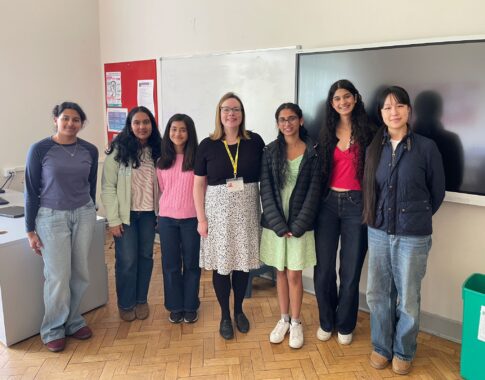
On Wednesday 6th May, we had the pleasure of welcoming associate professor Dr Rebecca McDonald, from the University of Birmingham to speak to students about Behavioural Economics. The talk gave a really interesting twist on a subject many of us usually link to money, banking, and exchange rates, showing that it is just as much about people and the choices they make.
One of the highlights was hearing about her own journey into economics. It was inspiring to see a woman sharing her experiences in a field that is not always seen as diverse, and it made studying economics feel like a much more realistic option for many students.
She began by asking us what we thought economics actually was. As expected, most answers focused on money and markets, but she introduced us to behavioural economics, which looks at how psychology affects the way people make decisions. This quickly showed that people are not always the perfectly logical decision makers that traditional economic theory suggests, as our choices are often shaped by habits, peer pressure, and what others around us are doing. We also explored the idea of a “nudge”, where small changes can influence behaviour without forcing a decision. A fun example was the “piano stairs”, where each step represents a musical note, encouraging people to take the stairs instead of the escalator. It was a simple idea, but one that clearly works. She also explained how similar techniques are used in marketing, for example through labels like “most popular” or by structuring options so that people naturally lean towards certain choices.
Another part of the session focused on experimental economics, where ideas are tested through real life experiments. Students even got involved in activities based on game theory, such as the prisoner’s dilemma and the dictator game, which made it easier to see how people behave in different situations.
Overall, the talk was both engaging and enlightening. It offered a completely different perspective on economics, showing that it is not just about numbers and markets, but about understanding human behaviour. Students left with a deeper appreciation of how economics influences everyday decisions and perhaps with a new curiosity about the subject itself.
Renia (Y12 Economics Prefect)