Last summer, 60 of our students sat the C3L6 Cambridge Chemistry Challenge, an exam designed to stretch and inspire young chemists across the country.
We are delighted to share that Jessica Z achieved an exceptional result, placing her in the top 0.5% of all students nationwide. This outstanding performance earned her the coveted Roentgenium Award – the highest accolade in the competition.
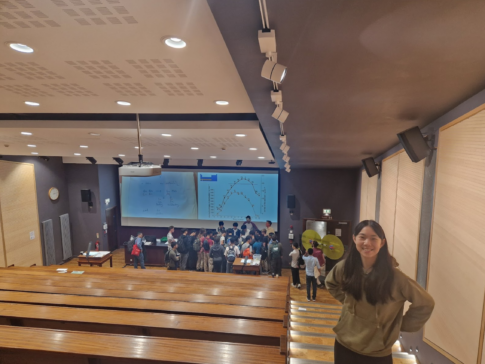
As recognition of her achievement, Jessica was invited to attend the Cambridge Chemistry Challenge Residential Camp, held at Cambridge University. This camp brings together some of the brightest young chemists in the country, offering lectures, workshops, and practical sessions led by world-class academics.
Here, Jessica talks to Miss Mehta about her experience.
What specific topics or experiments at the chemistry camp excited you the most?
There were 2 main experiments we did: firstly, determining the critical micelle concentration of SDS surfactant, and secondly, working out an experimental value of the Rydberg constant using the atomic emission spectrum of hydrogen. I enjoyed both of them but I’d say for me the second one was more exciting because we learnt the theory behind it beforehand and it’s such a fundamental constant of chemistry. Another topic that excited me was the particle in a box experiment with Schrödinger’s equation (arguably the most important equation in all of chemistry). Another topic that excited me was the shapes of the orbitals and the wavefunction describing an electron in an atom, which led to a couple of disturbing results, which all later seemed to be solved except that according to the wavefunction, electrons are most likely to be inside the nucleus!
Go to this link to see some orbitals! This is a website that Peter Wothers made (the man who was teaching and organising the whole camp).
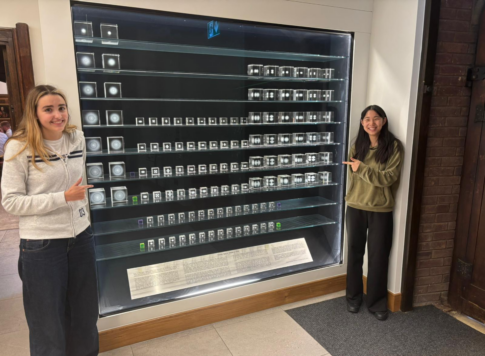
Another thing that excited me was when we learned about how the antibonding orbitals worked and Dr Wothers brought out a large model he built that showed the bonding and antibonding orbitals of two atoms. He explained how the antibonding orbitals affected the properties of different elements, and why tungsten and gold have such similar densities and why mercury is liquid at room temperature (which took him about one hour of talking about antibonding orbitals to get to).
Was there a moment when you connected what you learned at the camp to something from school or your own curiosity?
There were many moments at the camp which connected to what I learnt at school. For example, the shapes of the orbitals and that all the equipment in the Cambridge chemistry department lab was more accurate and precise.
Did you work with other students, and if so, what did you enjoy about that collaboration?
There were about 30 students at my chemistry camp. We were invited from achieving the Roentgenium award in the C3L6 challenge, a chemistry Olympiad-style paper aimed at year 12 students. More information about the C3L6 can be found online. I really enjoyed working with everyone, although I’d have to admit I spent the majority of my time there with my friend Sofia, the one other girl at the camp.
I really enjoyed collaborating with people who had the same passion for chemistry as me. For example, when solving the problem to calculate the energy of a hydrogen 1s orbital that Dr Wothers set us as optional work, a group of us all sat down together and did it for an hour in the evening. It was quite fun, and I liked collaborating with these people because I have no other group of friends who would want to do this.
I also liked meeting people from schools all over the UK. Some people had very different chemistry backgrounds, and some possessed a higher level of intellectual acumen than I. It made me feel a bit out of depth sometimes, but it was all part of the fun! I didn’t always understand everything in the lectures, but I didn’t mind because I always had my friends around me to ask for help.
Did the camp change the way you think about chemistry or science in general?
This camp changed the way I thought about chemistry because I realised that there is so much more chemistry to explore than what’s in the school syllabus. Previously, I hadn’t understood the considerable depth that every topic could go into. There are always more levels of complications you can add.
I also realised that you need some knowledge of all the sciences even if you only want to study chemistry because we covered elements of physics and biology during the camp as well, in order to understand the chemistry.
What’s one idea or concept from the camp that you couldn’t stop thinking about afterwards?
There were many ideas I couldn’t stop thinking about and it’s difficult to just choose one. Maybe for me the most memorable thing was the experiment that physicists like to call the ‘particle in a box’ (although it’s actually on a line and I wouldn’t call it a box). We used it to solve the Schrödinger equation for a simple case, and I found it so counterintuitive that the probability of the particle being at different locations on the line isn’t evenly distributed (for low energy systems), which is why I’ve kept thinking about it. Also the square cricket ball constantly moving at 2.21 x 10^-33 m/s.
Words from Dr Peter Wothers:
“It was a real pleasure teaching such a keen and motivated group of students. I was very impressed with how well they tackled the challenging problems. Jessica seemed to thrive on the course, and I wish her all the best with her continuing studies.”
Congratulations Jessica!