Written by Haniya M and Navyaa S, Year 10
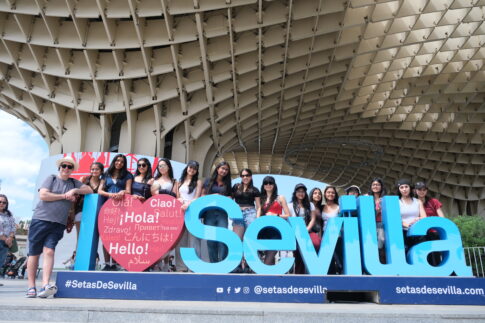
Our year 10 trip to Seville took place in the week beginning 11th May, lasting till 15th May, and with it being situated in the province of Andalucia, an area rich in culture, touristic sites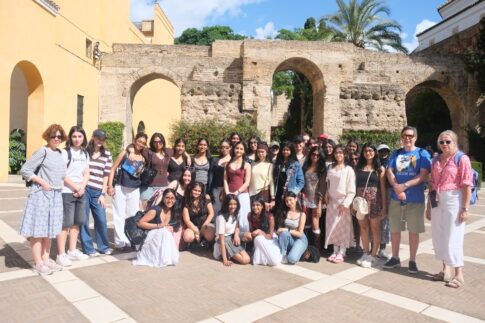 and history, it was a wonderful experience overall. We reached the airport bright and early at 3:45 am for our flight, ready to embark on the 3 hour flight and the following 2 hour drive to our hotel. On arrival, we dropped our bags off, before setting off on a guided tour around Seville, in Spanish of course, where we took in the many sites presented before us such as “Las Setas de Sevilla” (the Mushrooms of Seville), which serves as a modern building amidst a city of relatively older structures dripping with centuries of history and intricate architectural beauty. This, along with a cool cup of ice-cream at a local shop, served as a refreshing change of pace and scenery after the tiring voyage.
Tuesday had a more busy schedule: we spent the first portion of the day exploring the Real Alcázar de Sevilla, admiring the distinct culminations of architectural styles that adorned its walls: in fact, the palace is famous not only for its Islamic geometric designs and Quran verses stretching across several tiles and arches, but also for its blend of Gothic, Renaissance, and Baroque styles, serving as an official residence for the royal family. Once we had completed our look around, we walked to the Flamenco museum, where we were given an in-depth talk in Spanish surrounding Flamenco culture and the manner in which it had evolved over periods of time. However, the unanimously agreed highlight of the day was the Flamenco show we were able to watch: indeed, the dancers involved were truly splendid dancers. It was really beautiful to see and hear the guitar, singing, and dancing come together in harmony and create such a powerful and emotional performance.
 Wednesday involved a trip to Córdoba, where we set our eyes on a magnificent site, which could arguably represent the pinnacle of architecture with both Islamic and Christian elements, was “La Mezquita del Córdoba” (Córdoba Mosque). This structure was constructed in the 8th century during Muslim rule in Al-Andalus and was later converted into a Catholic cathedral after the Christian reconquest in 1236. The characteristic of the mosque that struck us the most was not the sombre yet tranquil atmosphere, but the vast “forest” of red-and-white double arches supported by hundreds of columns, stretching throughout for what seemed to be infinity. This, along with Gothic, Renaissance, and Baroque elements, including a cathedral nave built into the center of the mosque, introduced in later Christian additions, produced a complex, soothing environment, one that was enticing; captivating; alluring. We then proceeded to walk in the narrow but well-ventilated and pretty streets to the Córdoba Synagogue. With it being one of the few surviving medieval synagogues in the entirety of Spain, and located in the Judería [Jewish Quarter], the structure serves as an important reminder of the city’s Jewish heritage. Although it is quite small in size, it is considered one of the finest examples of Mudéjar architecture in a Jewish religious building, with such examples of finery being the beautifully decorated plasterwork and Hebrew inscriptions. After this, the teachers allowed us to explore the area and try Spanish cuisine, as well as to go shopping to our heart’s content for a whopping 3 hours — thank you, Señor Ross!
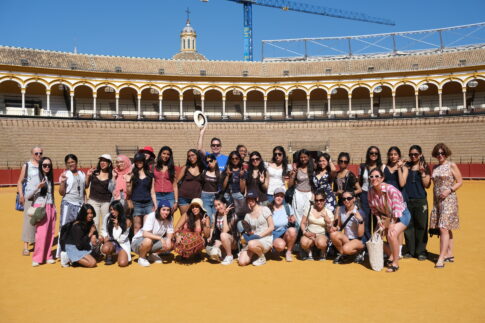
On Thursday we set off for the Plaza de Toros De la Maestranza, a bull ring constructed in the 19th century that is still functioning today! We first visited the museum, forming our own judgments on bull fighting, which for Spanish people is a respected art but in more recent times has been questioned for its ethics. We immersed ourselves in artwork, costumes, and real stuffed bulls before stepping out into the grand ring, surrounded by almost 13,000 seats and the sizzling sunshine. After that, we took a pleasant walk along the river (including leaping over a fence- our physical education was not forgotten!) and through a gorgeous garden to reach the Plaza de España. The architecture, including towers, bridges, and colonnades, was truly stunning and it felt like a scene from a fairytale. After that, we had plenty of time for shopping (We love ‘compras’ time!). Back at the hotel, at 9 o’clock, we all met on the rooftop, where the teachers had spent their evenings lounging by the pool, for our last night in Seville. We took advantage of the golden hour for some beautiful sunset photos and of course begged to stay for just one more week! Señor Ross also surprised us with souvenir wallets to remember the trip, which I think almost brought us all to tears.
On Friday we said goodbye to our lovely hotel, and headed back to Málaga. Our coach drive was accompanied by some excellent singing by Mrs Hersart, including Disney songs in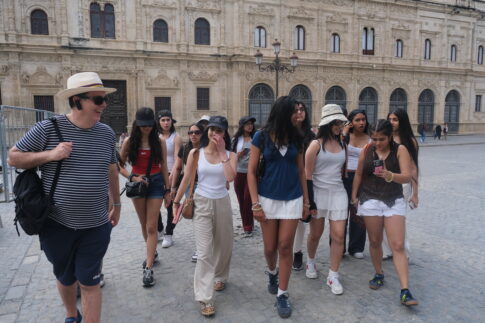 French and ‘Guess the Artist’, which Ms Price was an expert at. Since Málaga is the birthplace of Picasso, we visited the Picasso Museum. Unfortunately, the experience was not as good as we had hoped‐ the staff did not allow the teachers to explain the paintings to us. Nevertheless, we still gained an insight into Picasso’s mastery of various art styles beyond his famous Cubism, including works from when he was just 15 years old. After that we had free time to explore the town and buy our final Spanish souvenirs before returning to the airport.
Altogether, it was an unforgettable trip! We learned, laughed and even managed to get through the hot weather- around 28 degrees- all while practising our Spanish of course! During our free time for lunch each day, we had the opportunity to try traditional Spanish dishes including paella, tapas, churros, and various seafood, which was great for stepping out of our comfort zones. We returned home with beautiful hand-painted fans, a greater understanding of Spanish history and culture , and plenty of memories!